In the comfortable Upper East Side apartment of Sheila Camera Kotur, it’s as if everything has changed, yet nothing’s changed at all. There are hand-painted Louis XVI armchairs that Sheila finished with her own brush, hand-painted pillows on the billowy sofa, trompe-l’oeil frescoes on the walls and ceiling. There are also happy pictures of a family – mother, father, two daughters – that, together with the exclusively personal and hand-painted art work everywhere, makes the eclectic house and décor feel so much like a home.
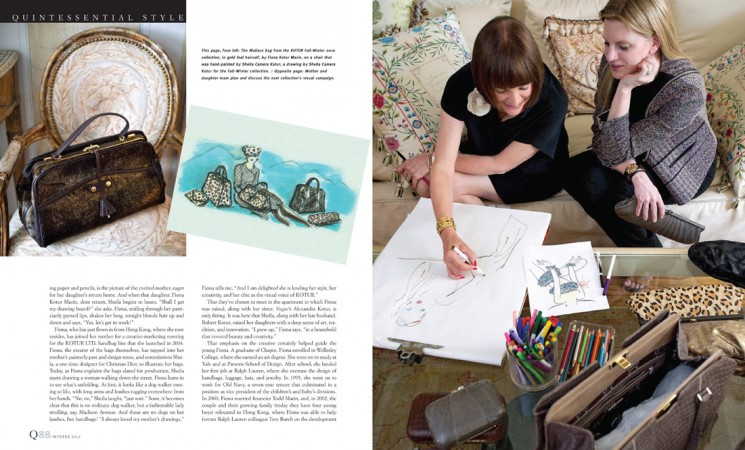
Sheila, with a perfectly coiffed dark-brown bob that flops alongside her as she scuttles from room to room to fetch drawing paper and pencils, is the picture of the excited mother, eager for her daughter’s return home. And when that daughter, Fiona Kotur Marin, does return, Sheila begins to beam. “Shall I get my drawing board?” she asks. Fiona, smiling through her patricianly pursed lips, shakes her long, straight blonde hair up and down and says, “Yes, let’s get to work!”
Fiona, who has just flown in from Hong Kong, where she now resides, has joined her mother for a creative-marketing meeting for the KOTUR LTD. handbag line that she launched in 2004. Fiona, the creator of the bags themselves, has tapped into her mother’s painterly past and design sense, and commissions Sheila, a one-time designer for Christian Dior, to illustrate her bags. Today, as Fiona explains the bags slated for production, Sheila starts drawing a woman walking down the street. Fiona leans in to see what’s unfolding. At first, it looks like a dog walker coming to life, with long arms and leashes tugging everywhere from her hands. “No, no,” Sheila laughs, “just wait.” Soon, it becomes clear that this is no ordinary dog walker, but a fashionable lady strolling, say, Madison Avenue. And those are no dogs on her leashes, but handbags! “I always loved my mother’s drawings,” Fiona tells me, “And I am delighted she is lending her style, her creativity, and her chic as the visual voice of KOTUR.”
That they’ve chosen to meet in the apartment in which Fiona was raised, along with her sister, Vogue’s Alexandra Kotur, is only fitting. It was here that Sheila, along with her late husband, Robert Kotur, raised her daughters with a deep sense of art, tradition, and innovation. “I grew up,” Fiona says, “in a household that revered beauty and creativity.”
That emphasis on the creative certainly helped guide the young Fiona. A graduate of Chapin, Fiona enrolled in Wellesley College, where she earned an art degree. She went on to study at Yale and at Parsons School of Design. After school, she landed her first job at Ralph Lauren, where she oversaw the design of handbags, luggage, hats, and jewelry. In 1995, she went on to work for Old Navy, a seven-year tenure that culminated in a position as vice president of the children’s and baby’s divisions. In 2000, Fiona married financier Todd Marin, and, in 2002, the couple and their growing family (today they have four young boys) relocated to Hong Kong, where Fiona was able to help former Ralph Lauren colleague Tory Burch on the development of Burch’s budding fashion line. Along the way, Fiona was inspired by the sources she was discovering in Asia, and eventually stumbled upon a trove of vintage brocades that were from a small mill owned by a ninety-year-old craftsman.
These brocades became the inspiration for her first collection of handbags, which she launched in 2004. Fiona fashioned a line of retro-glam brocade clutches, which were immediately picked up by retailers like Bergdorf Goodman and Scoop in New York, Harvey Nichols in Hong Kong, and Browns in London.
“I have always had a passion for handbags, so no one was surprised when I launched my line,” Kotur says. “I have been collecting bags for over twenty years, from flea markets and antique shops.” Her bags have expanded from that first brocade collection into an impressive line of clutches, daybags, totes, and satchels, in everything from fabrics and naturals to snakeskins and maille weaves. They are carried by some of the world’s most fashionable women, from private society ladies to international film stars, and they fall within a reasonable price range, from $350 to about $2,000. There is an emphasis on the old-school ladylike appeal, but also on “transition” bags, which can be carried everywhere, for any setting, with any outfit. “I love high-low,” Fiona explains, “I think that this is how best to shop and dress nowadays, and also how to structure your life and live it to its fullest.”
STYLED AND WRITTEN BY DANIEL CAPPELLO
PHOTOGRAPHED BY JOSHUA BRIGHT