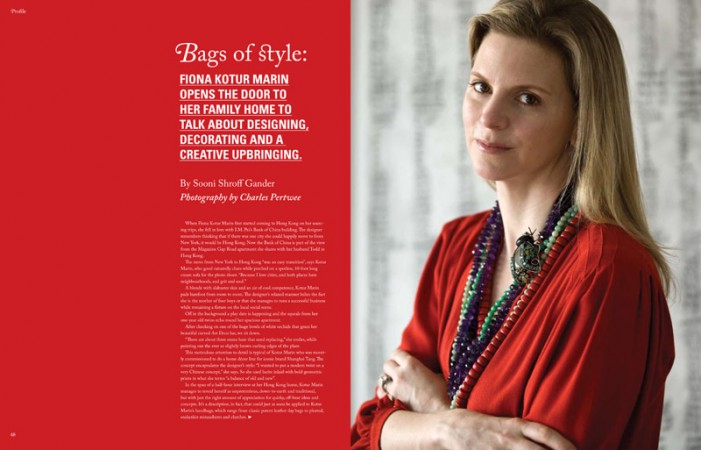
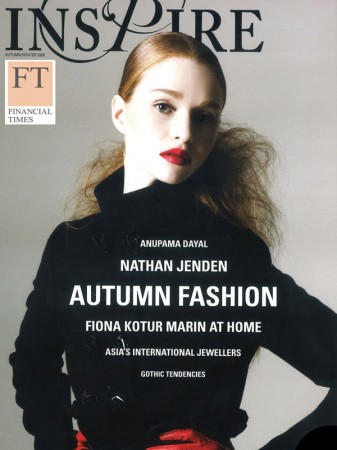
FIONA KOTUR MARIN OPENS THE DOOR TO HER FAMILY HOME TO TALK ABOUT DESIGNING, DECORATING AND A CREATIVE UPBRINGING.
By Sooni Shroff Gander
Photography by Charles Pertwee
When Fiona Kotur Marin first started coming to Hong Kong on her sourcing trips, she fell in love with I.M. Pei’s Bank of China building. The designer remembers thinking that if there was one city she could happily move to from New York, it would be Hong Kong. Now the Bank of China is part of the view from the Magazine Gap Road apartment she shares with her husband Todd in Hong Kong.
The move from New York to Hong Kong “was an easy transition”, says Kotur Marin, who good naturedly chats while perched on a spotless, 10-foot long cream sofa for the photo shoot. “Because I love cities, and both places have neighbourhoods, and grit and soul.”
A blonde with alabaster skin and an air of cool competence, Kotur Marin pads barefoot from room to room. The designer’s relaxed manner belies the fact she is the mother of four boys or that she manages to runs a successful business while remaining a fixture on the local social scene.
Off in the background a play date is happening and the squeals from her one-year old twins echo round her spacious apartment.
After checking on one of the huge bowls of white orchids that grace her beautiful curved Art Deco bar, we sit down.
“There are about three stems here that need replacing,” she smiles, while pointing out the ever so slightly brown curling edges of the plant.
This meticulous attention to detail is typical of Kotur Marin who was recently commissioned to do a home décor line for iconic brand Shanghai Tang. The concept encapsulates the designer’s style: “I wanted to put a modern twist on a very Chinese concept,” she says. So she used lucite inlaid with bold geometric prints in what she terms “a balance of old and new”.
In the span of a half-hour interview at her Hong Kong home, Kotur Marin manages to reveal herself as unpretentious, down-to-earth and traditional, but with just the right amount of appreciation for quirky, off-beat ideas and concepts. It’s a description, in fact, that could just as soon be applied to Kotur Marin’s handbags, which range from classic patent leather day bags to pleated, snakeskin minaudieres and clutches.
“I like to keep things simple,” says Kotur Marin, who is dressed in a red silk Marni blouse and her favourite Chloé trousers. “And then I dress it all up with the accessories.”
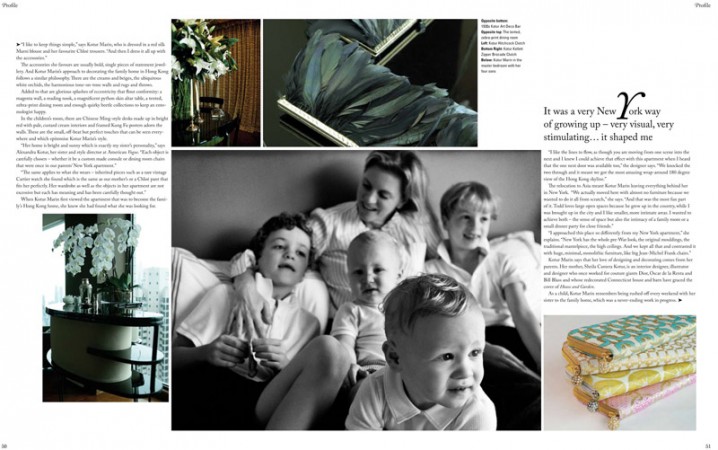
The accessories she favours are usually bold, single pieces of statement jewellery. And Kotur Marin’s approach to decorating the family home in Hong Kong follows a similar philosophy. There are the creams and beiges, the ubiquitous white orchids, the harmonious tone-on-tone walls and rugs and throws.
Added to that are glorious splashes of eccentricity that flout conformity: a magenta wall, a reading nook, a magnificent python skin altar table, a tented, zebra-print dining room and enough quirky beetle collections to keep an entomologist happy.
In the children’s room, there are Chinese Ming-style desks made up in bright red with pale, custard cream interiors and framed Kung Fu posters adorn the walls. These are the small, off-beat but perfect touches that can be seen everywhere and which epitomise Kotur Marin’s style.
“Her home is bright and sunny which is exactly my sister’s personality,” says Alexandra Kotur, her sister and style director at American Vogue. “Each object is carefully chosen – whether it be a custom made consule or dining room chairs that were once in our parents’ New York apartment.”
“The same applies to what she wears – inherited pieces such as a rare vintage Cartier watch she found which is the same as our mother’s or a Chloé pant that fits her perfectly. Her wardrobe as well as the objects in her apartment are not excessive but each has meaning and has been carefully thought out.”
When Kotur Marin first viewed the apartment that was to become the family’s Hong Kong home, she knew she had found what she was looking for.
“I like the lines to flow, as though you are moving from one scene into the next and I knew I could achieve that effect with this apartment when I heard that the one next door was available too,” the designer says. “We knocked the two through and it meant we got the most amazing wrap-around 180 degree view of the Hong Kong skyline.”
The relocation to Asia meant Kotur Marin leaving everything behind her in New York. “We actually moved here with almost no furniture because we wanted to do it all from scratch,” she says. “And that was the most fun part of it. Todd loves large open spaces because he grew up in the country, while I was brought up in the city and I like smaller, more intimate areas. I wanted to achieve both – the sense of space but also the intimacy of a family room or a small dinner party for close friends.”
“I approached this place so differently from my New York apartment,” she explains. “New York has the whole pre-War look, the original mouldings, the traditional mantelpiece, the high ceilings. And we kept all that and contrasted it with huge, minimal, monolithic furniture, like big Jean-Michel Frank chairs.”
Kotur Marin says that her love of designing and decorating comes from her parents. Her mother, Sheila Camera Kotur, is an interior designer, illustrator and designer who once worked for couture giants Dior, Oscar de la Renta and Bill Blass and whose redecorated Connecticut house and barn have graced the cover of House and Garden.
As a child, Kotur Marin remembers being rushed off every weekend with her sister to the family home, which was a never-ending work in progress.
“It was an eighteenth-century house, which my parents fell in love with but which needed complete restoring. And we did most of it ourselves. We chipped off the paint, dug in the garden, did everything in a very hands-on way. It was wonderful.”
What Kotur Marin recalls now, with an air of wonder, is the fact that her ever-chic, perennially-classic mother had three gardening outfits that she wore in rotation when she was digging up the shrubbery or potting new roses: “And all of them were Pucci, which we really never appreciated at the time.”
Her upbringing, she says, was “very Bloomsbury”. When the girls were not working on the Connecticut home they were being carted off to Sotheby’s and Christie’s auctions, dragged around the Met and taken to exhibitions and galleries. “It was a very New York way of growing up – very visual, very stimulating… it shaped me,” Kotur Marin says.
With an immaculate CV – she attended private schools, graduated from Wellesley and enrolled at Parsons for design – it was natural for Kotur Marin to end up working as a stylist at Ralph Lauren.
“It was wonderful,” she says, “because I learned so much technically. From Ralph I learned to really focus, to have a vision and follow it through single-mindedly and without compromise. The core values I came away with were, and still are, vision, craft and quality.”
Yet, despite loving her work at Ralph Lauren, Kotur Marin jumped at the chance to quit the luxury arena to help US retailer Gap launch their new concept, Old Navy.
“I loved the idea that you could have good quality and great design without being caught by the cost. This was pre- all that Isaac Mizrahi for Target type of thing,” explains Kotur Marin. “Old Navy was supposed to be very design driven but still reachable for most of middle America. And I loved the democracy of all of that. I didn’t see why someone with great taste should be penalised for not being able to afford quality and design.” And, as it turned out, it was excellent training for Kotur Marin’s own business.
Several years after Old Navy, the designer helped her friend, Tory Burch, start her eponymous line. But it was not until Kotur Marin was sourcing fabrics for her friend and came across an entire warehouse of vintage brocades languishing unused, that she thought about setting up her own company.
While most people might have felt a pang and just left the materials in the warehouse, Kotur Marin saw her chance. She bought the lot and with those reams of fabric she began making her signature evening clutches.
So successful was she that when there was no more brocade left, Kotur Marin started looking into other fabrics and materials.
“It’s one of those things about Asia,” she says, “that you develop really close relationships very fast.”
“We work with about 10 factories and I know the si fus really well. I know all their strengths and weaknesses and know when to push them – that’s something the Louis Vuittons and Pradas can’t do because it is too labour intensive and it happens at the grassroots level. Sometimes, I have to stay in the factories to make it work.”
Kotur Marin now sources materials from all over Asia: shell inlay from the Philippines, fabrics from Shanghai, lacquerware from Thailand.
“If I see something I absolutely love, I will have to get hold of it. At the moment, I have to get a particularly beautiful chainmail link from Germany that I set with Swarovski crystals – and I really can’t find the same quality and workmanship anywhere else.”
Kotur Marin admits that this can affect her price point but she is the first to point out that her collections have something for every woman.
“I wanted a broad range of prices with bags that are both really expensive and pretty reasonable. After all, don’t we all shop like that? If we see something we love and it is cheap, we are not going to disregard it just because it isn’t as expensive as some of our other stuff are we? At least I hope not. I’m not like that,” she laughs.
As a result, Kotur Marin’s bags vary from hemp and straw totes with beautifully crafted Chinese padlock details to classic, roomy leather day bags and sleek python skin clutches with origami rose embellishments or jade clasps.
Indeed, some of her Kotur bags are like exquisite sculptures or mini objets d’art with jewelled clasps, statement rocks, embellished skins and shimmering metallic tones.
With her mix of personal connections, Asian aesthetics, design inspiration, access to local artisans and creative vision, Kotur Marin has created a following.
After only four years in business, Kotur sales are upward of US$5m and she has been featured in Harpers Bazaar, Vogue, InStyle and W. Her bags are sold in over 200 boutiques in the US as well as department stores Bergdorf Goodman and Bendels.
International markets include the UK, France, Italy, Germany, Brazil, New Zealand and Japan with Kotur stockists including Harrods and Harvey Nichols in London, Hong Kong and Dubai.
Hollywood stars have also been attracted by the meticulously-crafted, sophisticated menaudieres, which are perfect for the red carpet.
Renée Zellweger, Anne Hathaway, Kim Raver and Drew Barrymore have all been spotted with Koturs. It also helps that global fashionistas continue to snap up her limited edition creations as quickly as she can get them out.
Lillian Wang von Stauffenberg – a close friend of Fiona’s from Wellesley days who consults for Asprey and carries the bags frequently, sums up Kotur’s appeal.
“My style is quite classic, but I hate boring accessories,” Wang von Stauffenberg says. “My favourite is a bag Fiona made her first season. It is a clutch made entirely of brown speckled feathers, it is like a work of art. It is actually so divine that I keep it in my sitting room on a side table. People are always picking it up.”
With so much appreciation for her work, it is amazing that Kotur Marin manages to stay so grounded. But perhaps what is so endearing about the designer is her utter enthusiasm and passion for her work.
“I love the 3D aspect of accessories,” she says. “Perhaps if I wasn’t a designer I’d be a sculptor.”