Precious and natural fibres and fabrics make the most desirable bags, writes Kitty Go
After years of totemic, branded leather ‘It’ bags, swinging from every other elbow like a uniform, a slew of lesser-known designer handbag ranges – predominantly from Asia – are coming to the fore, thanks to their focus on original design and the finest local materials.
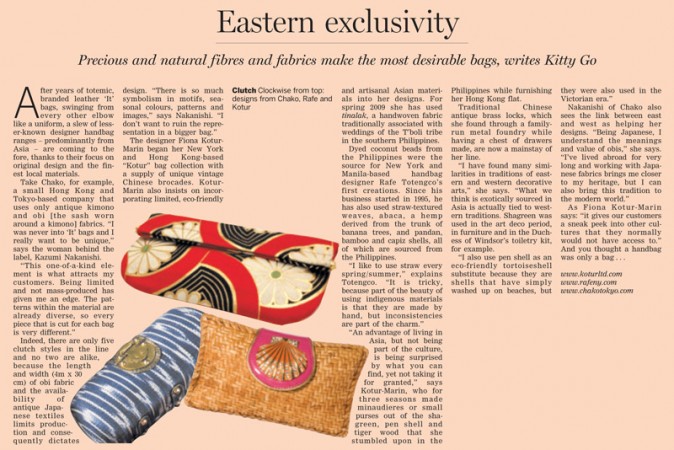
Take Chako, for example, a small Hong Kong and Tokyo-based company that uses only antique kimono and obi [the sash worn around a kimono] fabrics. “I was never into ‘It’ bags and I really want to be unique,” says the woman behind the label, Kazumi Nakanishi.
“This one-of-a-kind element is what attracts my customers. Being limited and not mass-produced has given me an edge. The patterns within the material are already diverse, so every piece that is cut for each bag is very different.”
Indeed, there are only five clutch styles in the line and no two are alike, because the length and width (4m x 30cm) of obi fabric and the availability of antique Japanese textiles limits production and consequently dictates design. “There is so much symbolism in motifs, seasonal colours, patterns and images,” says Nakanishi. “I don’t want to ruin the representation in a bigger bag.”
The designer Fiona Kotur-Marin began her New York and Hong Kong-based “Kotur” bag collection with a supply of unique vintage Chinese brocades. Kotur-Marin also insists on incorporating limited, eco-friendly Clutch Clockwise from top: designs from Chako, Rafe and Kotur and artisanal Asian materials into her designs. For spring 2009 she has used tinalak, a handwoven fabric traditionally associated with weddings of the T’boli tribe in the southern Philippines.
Dyed coconut beads from the Philippines were the source for New York and Manila-based handbag designer Rafe Totengco’s first creations. Since his business started in 1995, he has also used straw-textured weaves, abaca, a hemp derived from the trunk of banana trees, and pandan, bamboo and capiz shells, all of which are sourced from the Philippines.
“I like to use straw every spring/summer,” explains Totengco. “It is tricky, because part of the beauty of using indigenous materials is that they are made by hand, but inconsistencies are part of the charm.”
“An advantage of living in Asia, but not being part of the culture, is being surprised by what you can find, yet not taking it for granted,” says Kotur-Marin, who for three seasons made minaudieres or small purses out of the shagreen, pen shell and tiger wood that she stumbled upon in the Philippines while furnishing her Hong Kong flat.
Traditional Chinese antique brass locks, which she found through a family-run metal foundry while having a chest of drawers made, are now a mainstay of her line.
“I have found many similarities in traditions of eastern and western decorative arts,” she says. “What we think is exotically sourced in Asia is actually tied to western traditions. Shagreen was used in the art deco period, in furniture and in the Duchess of Windsor’s toiletry kit, for example.
“I also use pen shell as an eco-friendly tortoiseshell substitute because they are shells that have simply washed up on beaches, but they were also used in the Victorian era.”
Nakanishi of Chako also sees the link between east and west as helping her designs. “Being Japanese, I understand the meanings and value of obis,” she says. “I’ve lived abroad for very long and working with Japanese fabrics brings me closer to my heritage, but I can also bring this tradition to the modern world.”
As Fiona Kotur-Marin says: “it gives our customers a sneak peek into other cultures that they normally would not have access to.” And you thought a handbag was only a bag…