“Bags and accessories lend themselves to creating a more individual style and expression”
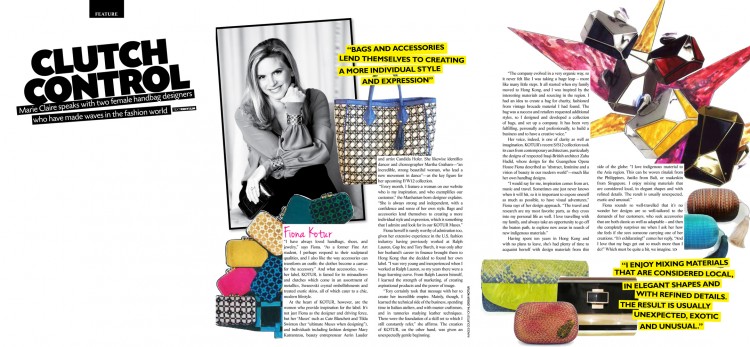
“I have always loved handbags, shoes, and jewelry,” says Fiona. “As a former Fine Art student, I perhaps respond to their sculptural qualities, and I also like the way accessories can transform an outfit: the clothes become a canvas for the accessory.” And what accessories, too – her label, KOTUR, is famed for its minaudieres and clutches which come in an assortment of metallics, Swarovski crystal embellishments and treated exotic skins, all of which cater to a chic, modern lifestyle.
At the heart of KOTUR, however, are the women who provide inspiration for the label. It’s not just Fiona as the designer and driving force, but her ‘Muses’ such as Cate Blanchett and Tilda Swinton (her “ultimate Muses when designing”), and individuals including fashion designer Mary Katrantzou, beauty entrepreneur Aerin Lauder and artist Candida Hofer. She likewise identifies dancer and choreographer Martha Graham—“an incredible, strong beautiful woman, who lead a new movement in dance”—as the key figure for her upcoming F/W12 collection.
“Every month, I feature a woman on our website who is my inspiration, and who exemplifies our customer,” the Manhattan-born designer explains.
“She is always strong and independent, with a confidence and sense of her own style. Bags and accessories lend themselves to creating a more
individual style and expression, which is something that I admire and look for in our KOTUR Muses.”
Fiona herself is surely worthy of admiration too, given her extensive experience in the U.S. fashion industry: having previously worked at Ralph Lauren, Gap Inc and Tory Burch, it was only after her husband’s career in finance brought them to Hong Kong that she decided to found her own label. “I was very young and inexperienced when I worked at Ralph Lauren, so my years there were a huge learning curve. From Ralph Lauren himself, I learned the strength of marketing, of creating aspirational products and the power of image.
“Tory certainly took that message with her to create her incredible empire. Mainly, though, I learned the technical side of the business, spending time in Italian ateliers, and with master craftsmen, and in tanneries studying leather techniques. These were the foundation of a skill set to which I still constantly refer,” she affirms. The creation of KOTUR, on the other hand, was given an unexpectedly gentle beginning.
“The company evolved in a very organic way, so it never felt like I was taking a huge leap – more like many little steps. It all started when my family moved to Hong Kong, and I was inspired by the interesting materials and sourcing in the region. I had an idea to create a bag for charity, fashioned from vintage brocade material I had found. The bag was a success and retailers requested additional styles, so I designed and developed a collection of bags, and set up a company. It has been very fulfilling, personally and professionally, to build a business and to have a creative voice.”
Her voice, indeed, is one of clarity as well as imagination. KOTUR’s recent S/S12 collection took its cues from contemporary architecture, particularly the designs of respected Iraqi-British architect Zaha Hadid, whose design for the Guangzhou Opera House Fiona described as “abstract, feminine and a vision of beauty in our modern world”—much like her own handbag designs.
“I would say for me, inspiration comes from art, music and travel. Sometimes one just never knows when it will hit, so it is important to expose oneself as much as possible, to have visual adventures,” Fiona says of her design approach. “The travel and research are my most favorite parts, as they cross into my personal life as well. I love travelling with my family, and always take an opportunity to go off the beaten path, to explore new areas in search of new indigenous materials.”
Having spent ten years in Hong Kong and with no plans to leave, she’s had plenty of time to acquaint herself with design materials from this side of the globe: “I love indigenous material to the Asia region. This can be woven tinalak from the Philippines, batiks from Bali, or snakeskin from Singapore. I enjoy mixing materials that are considered local, in elegant shapes and with refined details. The result is usually unexpected, exotic and unusual.”
Fiona sounds so well-travelled that it’s no wonder her designs are so well-tailored to the demands of her customers, who seek accessories that are both classic as well as adaptable – and then she completely surprises me when I ask her how she feels if she sees someone carrying one of her creations. “It’s exhilarating!” comes her reply, “And
I love that my bags get out so much more than I do!” Which must be quite a bit, we imagine.
“I enjoy mixing materials that are considered local , in elegant shapes and with refined details. The result is usually unexpected, exotic
and unusual.”
Text: RenyiLim